
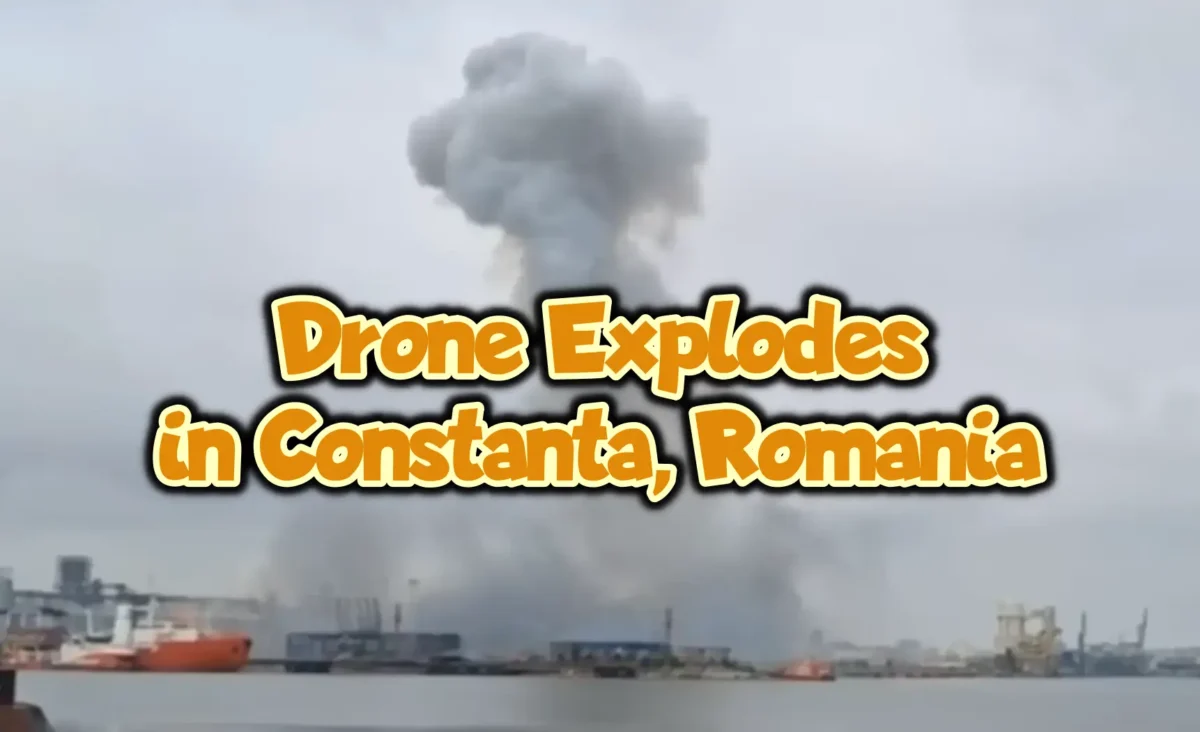
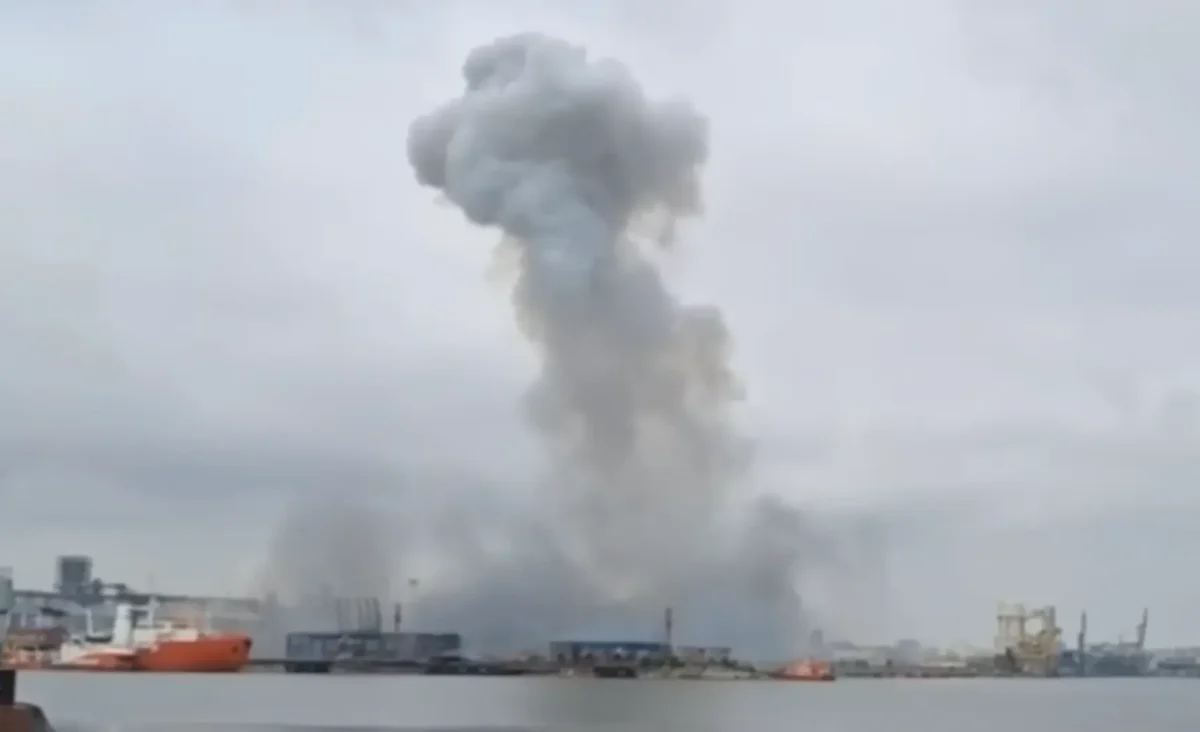
A high-explosive marine drone, self-detonated inside Romania’s largest Black Sea port, Constanta, on Friday morning at around 10:28, Romania time.
Since I lived, together with my family, for two years in Constanta, this news hit hard. But I will be as objective as possible and report everything we know so far – and it’s A LOT, in a situation that changed a few times during the day.
The uncrewed surface vessel exploded at Berth 78 of the Port of Constanța, extremely close to a major oil and gas loading terminal.
While authorities confirmed there were no casualties, the blast caused major damage in the vicinity, rattled windows across the city and caused a lot of panic.
Here is the explosion, captured live during two live streams – the first is a close call, showing the smoke after the explosion:
The second video shows just how huge the explosion was, as the reporter transmitting live at that moment had to cover her ears:
Thousands of tourists evacuated
Following the seadrone explosion, authorities began evacuating thousands of tourists on the Black Sea coast, as well as port workers, claiming that other drones might still be putting the shores in danger.
Recently, Raed Arafat, Department for Emergency Situations’ leader, announced that the situation has stabilized and no immediate dangers exists, allowing tourists to return.
However, this explosion heightening fears that the war in Ukraine is increasingly spilling over into NATO territory, especially as it happens just one week after a drone crashed into an apartment building block in Galati, Romania, causing massive damage.
The twist here is that now it is confirmed that the Constanta explosion was caused by a Ukrainian drone, as opposed to the Galati one, which was attributed to the Russian forces.
A Port Paralyzed and Coastlines Cleared
As I mentioned, immediately after the explosion, the Romanian authorities scrambled to secure the coastline.
The Department for Emergency Situations (DSU) activated a “Red Intervention Plan,” deploying dozens of fire engines, ambulances, and specialized chemical, biological, and radiological (CBRN) units.
The emergency response included:
- Mass Evacuations: Police and local authorities cleared the famed Casino promenade in Constanța and evacuated over 1,000 tourists from popular beaches stretching from Sulina in the north to Mangalia in the south.
- Emergency Alerts: Multiple “RO-Alert” (emergency alert messages delivered to mobile phones) warnings were sent in Constanța and Tulcea, instructing residents to stay at least one kilometer away from the shoreline. A Code Red warning for explosion risk was also briefly issued for the resort town of Costinești.
- Medical Mobilization: The Constanța County Emergency Hospital initiated a “White Plan,” an extreme emergency protocol that recalled all 4,000 medical staff, including off-duty doctors and residents, to prepare for potential mass casualties. Fortunately, this was not needed.
By mid-afternoon, authorities announced that the immediate threat to the civilian population had passed and began lifting evacuation orders, though the port remained under strict military lockdown.
Electronic Warfare and Missing Drones
The Ukrainian Navy swiftly claimed ownership of the rogue vessel, identifying it as a Magura V5 – a type of agile, explosive-laden drone frequently used by Kyiv to harass Russia’s Black Sea Fleet.
According to Ukrainian officials, the drone was actively engaged in operational missions when it was effectively “blinded” and hijacked by Russian electronic warfare.
“One of the uncrewed surface vessels of the Naval Forces… lost control under the influence of the enemy’s electronic warfare means and ended up near the coast of Romania,” the Ukrainian military said in a statement, adding that they had provided real-time intelligence to Romanian authorities to prevent civilian casualties.
You can see the post on Twitter below:
However, the threat may not be entirely neutralized. Constanța County Prefect Adrian-Teodor Picoiu revealed that the exploded vessel was part of a larger swarm of five drones, according to reports from Romanian media company G4 Media.
According to intelligence provided by Ukraine, one drone exploded in Constanța, another detonated in Ukrainian waters, and three remain unaccounted for.
Some confusion surrounds the operation
Even though the drone itself self-detonated at 10:30 AM, it was actually spotted early in the morning, at 6:30, by ARSVOM, the national maritime rescue agency.
The gray, unmarked military vessel floated into the harbor and got stuck in an anti-pollution barrier just a few hundred meters from the oil terminal. You can see it in the video below:
Though disaster was averted by the timely evacuation of the immediate area, the 10:28 a.m. blast was powerful enough to cause structural damage to a nearby port warehouse and an adjacent commercial vessel.
The explosion also started a diplomatic war of words locally between Romania’s already fractured political and security apparatus.
The Romanian Ministry of National Defense (MApN), led by USR’s Radu Miruță, and the Romanian Naval Authority (ANR), headed by PSD-backed Dan Catană, have publicly traded responsibility for the failure to detect the drone before it breached the civilian port.
The Naval Authority claimed the drone’s low profile made it “difficult or impossible” to detect with standard civilian radar, while the Defense Ministry insisted that monitoring naval traffic is strictly the ANR’s jurisdiction and not theirs.
Swift International Response
European Union leaders were quick to condemn Moscow after the incident.
Ursula von der Leyen, President of the European Commission, and Kaja Kallas, the EU’s top diplomat, issued statements framing the incident as a direct consequence of Russian aggression. French President Emmanuel Macron was also quick to announce his country’s support for Romania.
“The explosion of the drone in the port of Constanța demonstrates that Russia’s war is increasingly spilling over into EU territory,” Kallas wrote, laying the “ultimate responsibility” entirely on the Kremlin.
The Russian Embassy in Bucharest fired back, categorically denying involvement in the sabotage and accusing the “Kyiv regime” of utilizing the drones to commit “terrorist acts” against civilian shipping in the Black Sea.
Romanian President Nicușor Dan, who was briefed on the crisis while flying to a summit in Montenegro, assured the public that “people will be safe” and called for heightened vigilance.
For now, the Black Sea coast remains heavily monitored, and the locals (and probably tourists, too) a bit worried, just like those in Galati.
My closing thoughts
I have to admit that seeing things like this is unnerving, but I understand that these are the risks when you have a war at your country’s borders.
The fact that Constanta was affected felt personal with me, as I ended up loving this city with all my heart after living there for a couple of years.
But any city in any country could be the next one targeted (or become a collateral victim) of a war that results in countless lives lost, shattered dreams, and terrifying situations. This is why I believe that wars will never be a solution to any kind of problem – they will just generate more problems instead.
I tried to put myself into the shoes of the Calin living in Constanta a few years ago, and I realized that I would’ve been worried, even though there were no victims today. But I would’ve been worried.
This means that I understand those who might also be reluctant about traveling to Constanta in particular, or Romania in general. While I still trust the authorities and our country’s partners are doing everything possible to keep people within Romania’s borders safe, and I do consider Romania to still be generally safe, I would also not try to convince anyone to visit the Eastern parts of the country at the moment.
It’s a sad situation, it’s both scary and enraging, and it just proves the one thing that most of us knew already for quite some time now: this war needs to end as soon as possible!
(sources for this news: G4 Media, Digi 24, Antena 3).

I am a journalist and local expert who has been documenting life in Romania since 2013. Based in Constanta (after living in Bucharest and Drobeta Turnu Severin), I provide up-to-date, on-the-ground advice for expats and travelers. My articles are based on real life experiences and plenty of research – from paying Romanian bills to exploring the wild “Rawmania” countryside.
That sea drone explosion was certainly a close call. Early in the war, Ukraine had some success with those sea drones. But they move relatively slowly and can be sighted from afar, giving plenty of time for defensive measures. More recently, the Ukrainians have been using air drones against Russian warships and just had a major success the other day. I can imagine the Russians would gleefully redirect any Ukrainian drones they could gain control of towards a NATO port. If so, this is the second Russian attack on the same NATO member country. So far, NATO has only responded with “strong words” for Russia and solidarity with Romania. Putin is no doubt emboldened by Donald Trump’s loud disparaging of the NATO alliance which he feels should have been more supportive of his military adventure in Iran. I don’t know if the European economic embargo screws can be tightenend any further against Russia. The head of NATO, Mark Rutte, has been slavishly flattering Trump for months now, perhaps in an attempt to save the NATO alliance, but he is not getting any love in return. In the meantime, Romania should close the Russian embassy in Bucharest and expell all Russian staff. I thought closing the Russian Consulate in Constanza was a very weak response to the first attack. Google AI tells me there are no other Russian consulates to close.
Yes, the situation is certainly tense and difficult to manage with so many other things happening in the world. But I agree – in this type of situation, any hesitation or sign of weakness will probably be heavily penalized. Time will tell if these words were enough…