
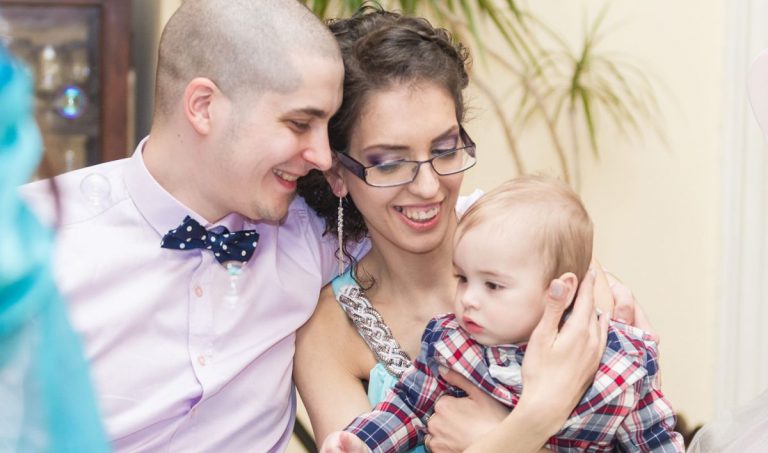
A baby’s baptism (or christening) in Romania is a really big thing. One of those important events in a family’s life, which rivals the wedding in sheer scale, expense, and emotional weight.
This means that the baby’s baptism can turn into a humongous party with hundreds of guests, plenty of food and drinks, and overall a party that lasts all night long and is made to impress.
Parents spend almost as much on organizing this party as they do for their wedding. It is a pretty huge thing here!
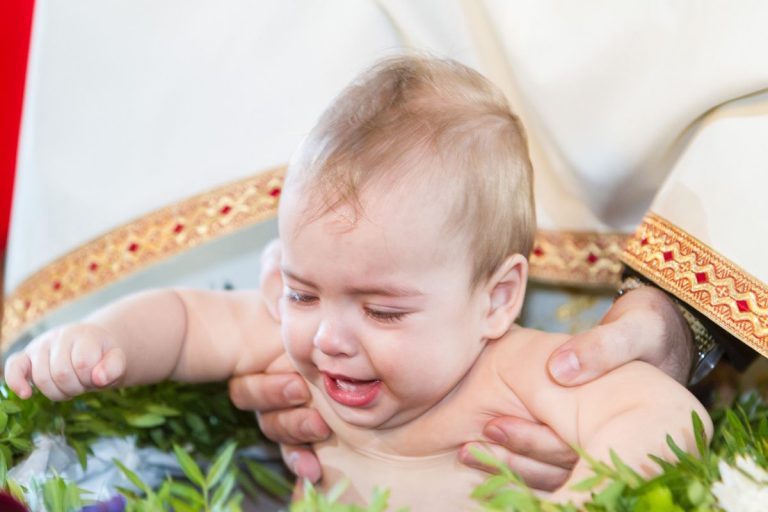
Despite some outdated practices (some priests completely submerge the babies under water, three times in a row!), a Christening party is usually really fun.
And that is what we’re going to talk about today: everything you need to know about the Romanian orthodox baptism – traditions, gifts you should bring and what to expect from this huge celebration.
Personal experience with baptism in Romania
I have firsthand experience with everything involving a child’s baptism in Romania since we had to baptize our son back in 2014.
Not much has fundamentally changed in the church rituals since then, though the prices and party expectations have certainly evolved – but as a local that also went to plenty of other baptism parties, I can assure you I’m giving up-to-date information.
Preparations for the church and party
First of all, it’s the parents (mostly) and the baby’s godparents who have to do a lot of preparing before the big day. Friends and the extended family just come to enjoy the party.
You have to book your date with the Church and make sure that you bring everything the priests tell you to (candles, clothes for the baby and different other things – they will give you the list), but also make arrangements at the restaurant for the party that follows (menu, decorations, music and other things).
For us, it was pretty stressful, I have to say, especially because we’re not very familiar with all the traditions (and everybody seems to think that you “must” this or that, many being just outdated Romanian superstitions), but in the end, all went well and we had a memorable, fun day.
Since an image is better than a thousand words, I am sharing a few from our son’s baptism day to outline the most important steps.
The Romanian Orthodox Church Ceremony
You start the day with the ceremony that takes place at the church. For most of this service, the godparents hold the baby and the parents take a step back.
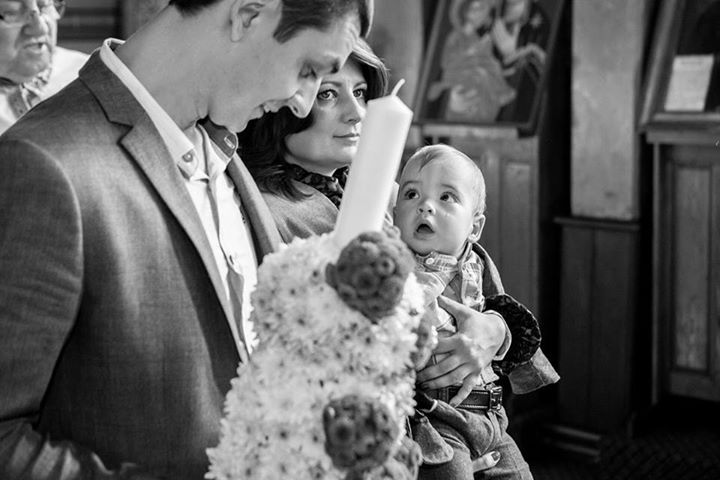
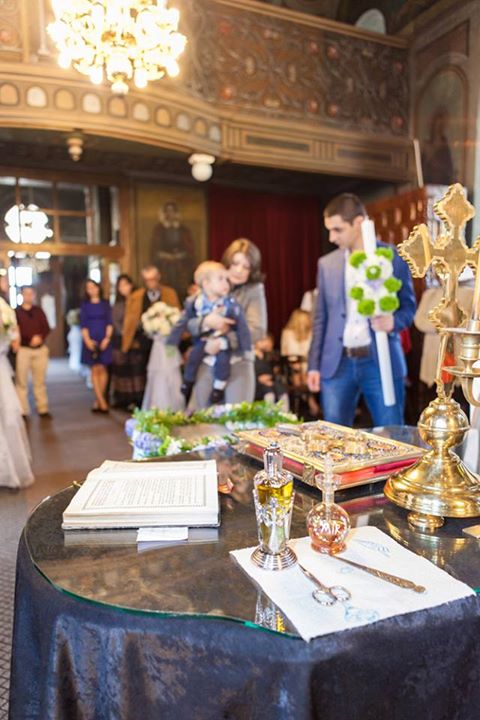
In the church, all the things on the table you can see in the photos below are used during the christening: there is a bottle of chrism, and a bit of this holy oil goes on the baby’s head.
Some is also put in the water used for the christening itself, the small scissors are used to cut a bit of hair (which the parents will hold onto forever), and the golden crosses and Bible are there to be kissed by the Godfathers at different moments during the ceremony.
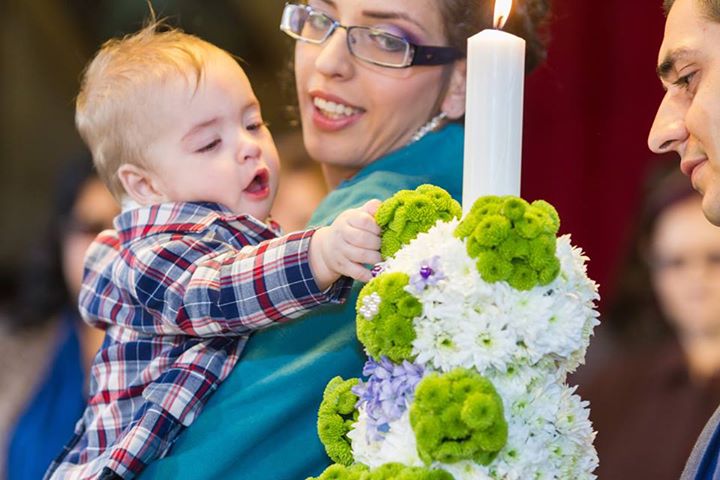
You can also notice in the background the special candle – it has to be held by the Godfather and it is decorated specifically for the moment – we went for a cutesy little flower teddy bear that we liked so much!
After the priests read their part from the Bible, the baby is placed into the holy water and the baptism is complete.
Normally, the baby is supposed to be completely submerged in the water three times in a row, while the priest holds their nose so that they don’t breathe in the water.
This can be an intense and shocking moment for the babies, and as a result, more and more priests just put some water on the baby’s head symbolically.
Parents can also ask the priest(s) not to submerge the baby, but in the end, the priest does whatever he wants.
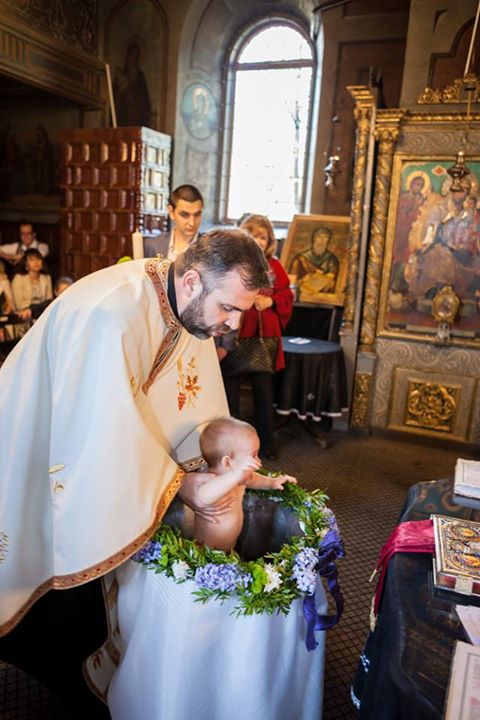
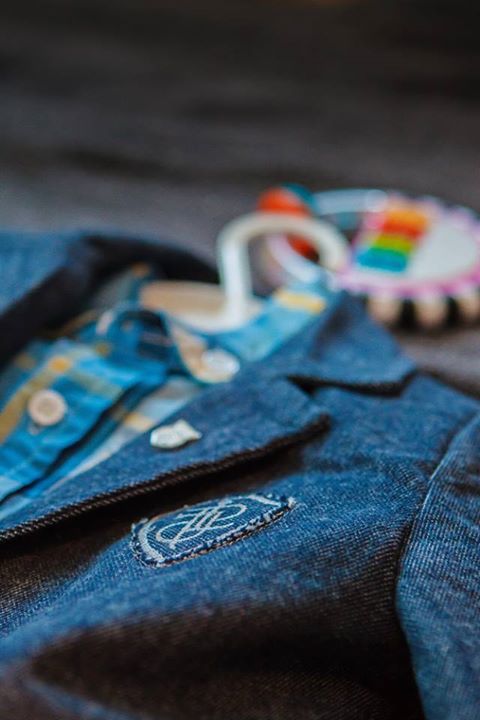
After the “bath” the baby is changed into a new set of clothes (the tradition has it that these have to be bought by the Godparents) and he’s allowed to play with anything, as long as he remains happy and stops crying:
The Christening / Baptism Party
After the Christening ceremony is over, everybody heads to the restaurant for the party – usually straight from the Church, but there might be a delay in some cases if the procession is too early in the day.
In many cases, the party will actually start later in the evening and last all night. We started early in the afternoon, and the party ended before midnight.
So it’s not set in stone when the actual party is going to start – the parents are the ones who decide. But usually, it’s considered more important for friends and family to be at the party itself than the church ceremony.
(This is basically because a gift is expected from guests, and the gift is offered at the restaurant, before the end of the party – more on this below.)
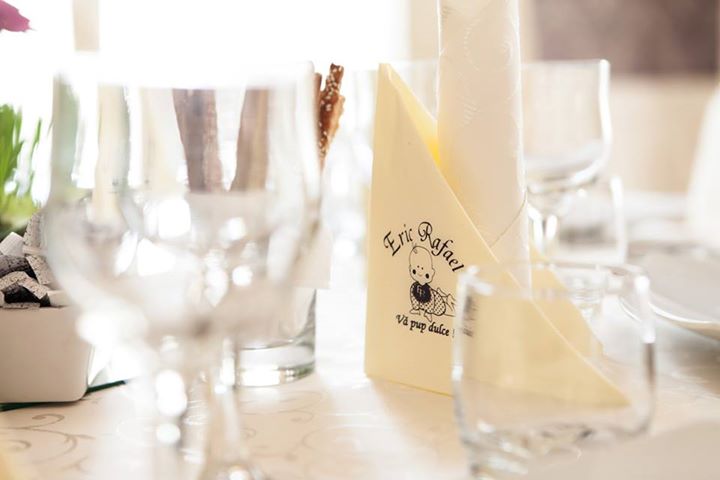
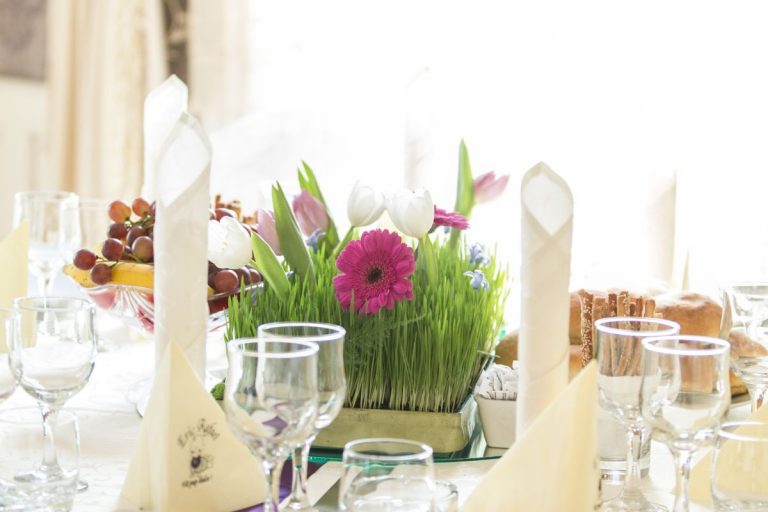
At the restaurant, you are expected to have themed decorations and basically everything you’d get from a wedding. We even got some cutesy personalized paper napkins:
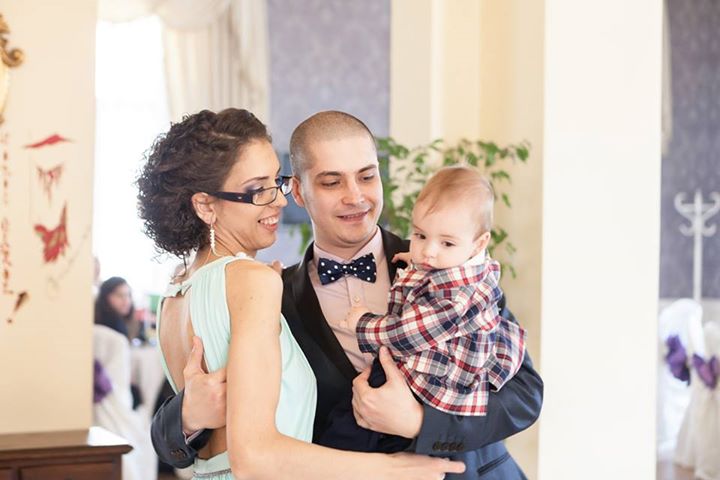
Just as it happens with weddings, the party is started by the first dance where the parents and the baby take the scene.
However, since you can’t really do much choreography with an infant (there are people who baptize their babies when they’re 2 months old), the three will only dance alone for several seconds before being joined by the others and the party officially begins.
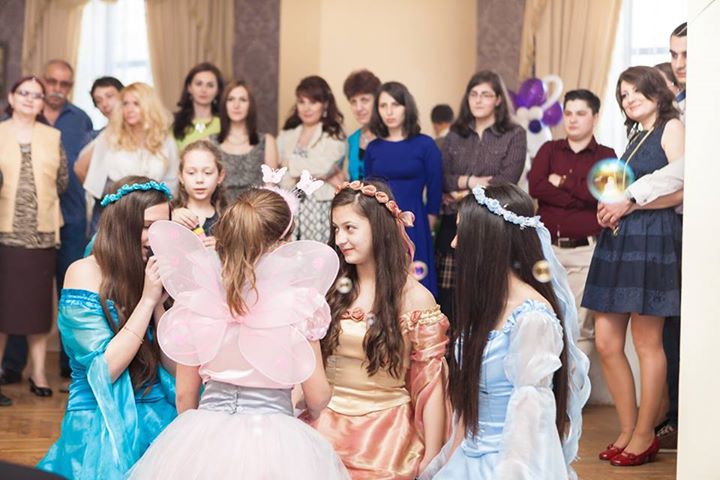
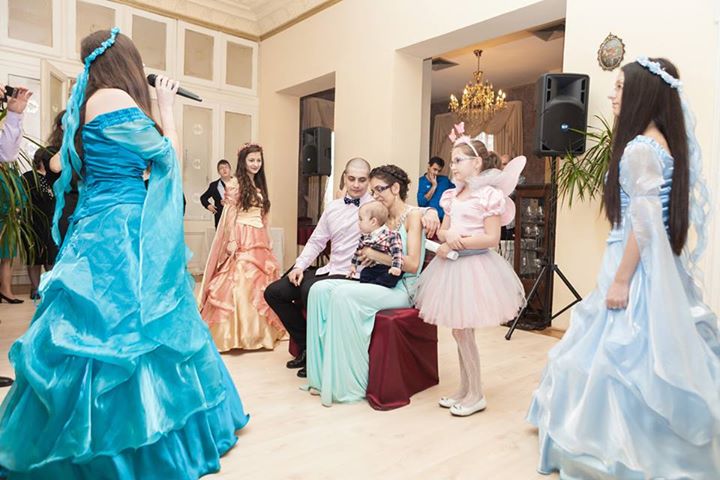
Later on, usually at midnight (but we opted for a day party, so they came at 7 PM, ha!) there is a special moment when fairies visit the baby to wish him well for a great destiny.
In Romanian, these fairies are called “Ursitoare” and the word basically means “the girls who decide fate”.
And after three or four courses, plus cake, plus a lot of alcohol, the day is over. Not before you party like the rock star you are!
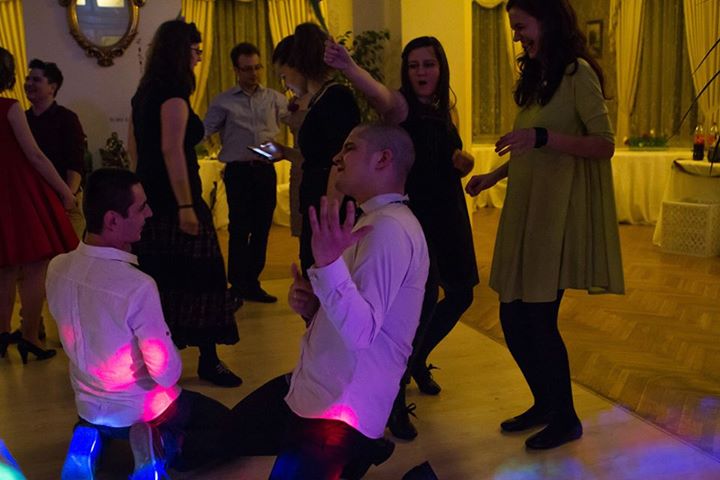
We went for a more modern approach to the whole thing and got a DJ for the music, but it’s still very common to bring a traditional Romanian band or singer who will perform traditional Romanian music while the guests dance the “hora” – a traditional dance with complicated steps and many variations, something that I never managed to master.
Plus, you can always have the controversial manele at some parties in Romania, including Baptism parties.
These are usually catchy and melodic – and it’s even better for foreigners who can’t understand the lyrics (which are, in most cases, moronic).
The Baptism Gift Etiquette: How Much Money to Give (Darul)
Yes, it is usually expected from all guests to offer a gift at the end of the day (when the Christening party ends). Usually, guests put some money in an envelope that is given to the parents.
The christening of a baby is the second biggest party in a Romanian’s life, and organizing it is very expensive.
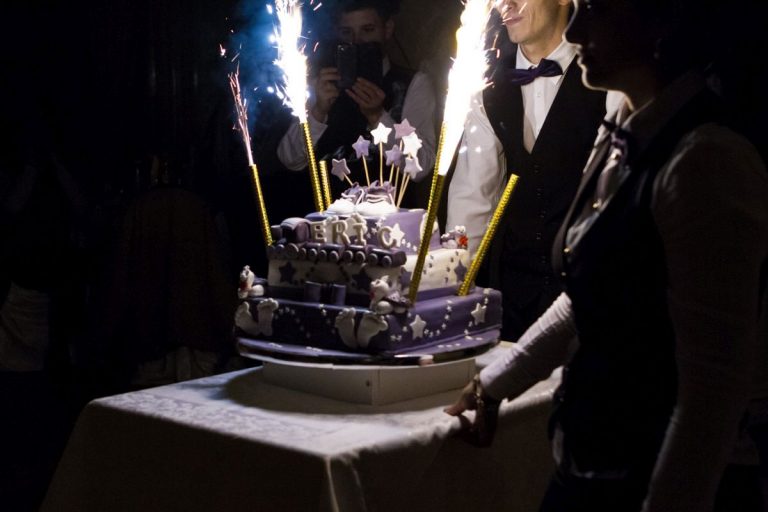
The biggest question people ask is “how much money to give?” but the truth is that there’s no exact answer here.
Normally, you are expected to pay at least the amount that would cover your restaurant bill, as well as your share for the music, decorations and everything else.
Then try to add a bit of extra for the parents if you can afford it. Now, actually knowing how much these cost is the tricky part because the organizers don’t make this information public.
To help you a bit, here is a breakdown of what you’re expected to place in your envelope, based on the type of guest you are (because that matters too):
- Standard Guest (One Person): 100 – 150 Euros (But more is appreciated)
- Couples: 200 – 300 Euros
- Close Friends (Per Person): 300 Euros and above
- Close Family (siblings of the parents, parents of the parents): 450 Euros and above
- Godparents (Nașii): 1000+ Euros
Generally speaking, close relatives and very close friends are expected to offer more money than the average guest. The godparents are the ones who, by tradition, should offer the most money out of everyone in the room.
The numbers above can and will be influenced by many factors. Larger cities are more expensive and you’re expected to gift more (the amounts above should be safe in Bucharest and other larger cities), while smaller cities will usually have lower costs.
I strongly advise you to play it safe and start from 150 Euros per person if you can afford it.
Remember that you are not expected to sell an arm and a leg to offer a monetary gift, though. Just offer as much as you feel is fair or what you can comfortably afford, and focus on enjoying the party.
We had people who were in a bad financial situation at the time of our son’s christening. We insisted on them coming even if we knew they could not afford to give us any gifts – so if you’re in a similar situation and the parents insist you go, go to the party and have fun!
We didn’t really kept track of who offered the most money or how much each guest gave us. We were there to have fun with family and friends – and that we did.
It is true that these parties used to be extremely “profitable” back in the day, with people buying cars or even apartments with the money made after the event (or at least a new kitchen or a fancy vacation).
Today, though, the money generally only covers the expenses for everything and it all evens up in the end, even if some offer less – because some will always want to shine and offer more.
Have in mind that only the parents will know how much you’ve given them (since you usually put the money in an envelope), and if you don’t want to sign it, you can offer it as an anonymous gift.
But everybody signs theirs, so you’d still be identified if the parents really want that.
Can you bring a regular gift instead of money?
While this is not common, it is becoming more and more popular in Romania.
At the moment, there aren’t lists of items needed by the family that you can choose from, but if you want to offer a gift instead of money, you can definitely do so.
But try to make sure that the thing you offer is actually useful, especially if it’s a bit more expensive.
No need to give them a brand new microwave oven, if they already have one which works fine (better give them the money instead, so they can get whatever they actually need).
In the end, in our case, what mattered the most was to have fun during our son’s Christening party and that we did.
We were not expecting the people to give us any money (although all of them did because that’s how things around here go), but we were grateful that we didn’t have to pay by ourselves for feeding and entertaining the crowd for one entire day.
The Heavy Burden of the Godparents (Nașii)
In Romania, the godparents (known as nașii) are considered the baby’s spiritual parents and they also carry the heaviest load (financially included) during the big day.
They will spend quite some money for the event, so be prepared if you are to be a godparent! You are expected to buy the baby’s entire outfit for the church, a baptism kit containing the towels for the priest, the holy oil bottle, the myrrh cloth, and the baby’s blanket.
On top of this, the godparents pay the church fee and buy the large ceremonial candle and are expected to give the most substantial monetary gift at the party.
And while being a child’s godparent is indeed a blessing and a huge honor, it’s also expensive.
Love reading Romania Experience? Support my work on Patreon to help fuel future guides, constant updates, and get ad-free access as a thank you!
Conclusion
There are plenty of traditions when it comes to the Christening party in Romania and the different regions of the country have different traditions.
I have tried to present a few of them above, as well as a general overview of the event which, overall, pretty much the same all over the country.
If you have additional questions about baptism in Romania, let me know in the comments section below!

I am a journalist and local expert who has been documenting life in Romania since 2013. Based in Constanta (after living in Bucharest and Drobeta Turnu Severin), I provide up-to-date, on-the-ground advice for expats and travelers. My articles are based on real life experiences and plenty of research – from paying Romanian bills to exploring the wild “Rawmania” countryside.
What a beautiful family you have, C!!! I wish Christenings were as important here as they are in Romania. They’re somewhat not a big deal here, although we did have parties for our kids with aunts, uncles and grandparents. Thanks so much for sharing about this: looks like it was a picture perfect event. You are blessed, my friend!
Thank you, Laurie! I, personally, enjoyed it more than our wedding :))
“C”: Wow! That is quite an event! Baby “C” looks very natty in his checkered coat;-)
My experience, here in the USA, is a quick annointing (or dunking depending on faith) by a priest and maybe a very little after-event (celebration) at home. Certainly NOTHING on the scale of Baby “C’s” fete! (BTW: Did Baby “C” get any toys? It looks like he was “into” that teddy bear(?) in front of the candle as pictured above.
So, I see you and the godfather are great air-guitar players;-) Clapton rocks!
Will we see the event on You Tube?
Take care,
~Teil (USA)
Hello, Teil! That Teddy Bear was made all out of flowers and I think it was the first time he saw one (at least from such a close range). But yes, he loves toys generally and turns everything into his toy 🙂 Unfortunately, he didn’t get any toys as gifts as the tradition is to only give money… but he did have a bag of them to enjoy at the party :)) And unfortunately, the event won’t be on YouTube. No free laughs for you guys :))
What a wonderful job you did describing and illustrating the Romanian christening tradition! Reading it I re-lived mine with my kids.
I am glad you liked it!
Extremely interested in your Christening article. My daughter is English and her husband Romanian,next year my grandson is being christened in Romania. I so wanted to buy his outfit but was told that traditionally God parents buy everything and it wasn’t allowed. I was told parents have little to do with his christening and it has to be done before he is a year old. My daughter was upset for us but understands the importance of traditions.
Has this happened to any dual nationality parents
Traditions are slightly different based on the area where the event is taking place and there are few things set in stone, it all depends on how open the parents are to changing things a bit or altering them a little. In our case, the Christening was made after the baby’s first anniversary, we bought all the clothes and so on. The most important thing is to enjoy the day!
Hello J.E! Just one tiny detail my husband forgot. We actually choose the outfits and candles, BUT his godparents payed for them. I think they wanted to stick to the traditions more than us, though they weren’t too informed on the matters. We hated to ask for things or let them handle too many things, so we did most on our own. To be honest the outfit he was changed into had no other purpose than that day only. Babies grow fast and we didn’t go to any events that year. So I think you should buy something that really matters and your grandson will use more than once.
And traditions are just that, traditions, not religious laws, so anyone can get baptized at any time. It is said you need to do it before 1 because he’ll get holly protection, or another silly tradition is that you can’t call the baby by his name until after baptizing, or you should not get them outside if he’s not baptized….as my husband mentioned, traditions differ on the areas you’re in, but almost every Romanian tradition is full of nonsense and superstitions that some choose to believe in, and others (us) don’t. The families, Romanian parents and grandparents, put GREAT pressure on the young parents, more than they should as they already are stressed with a new baby, so this is just something it needs to be done, the WAY it is said and set in stone (though I swear every year I’m hearing about traditions I’ve never heard of), and let them do it for THEIR piece of mind.
Gifts like expensive jewelry, like a gold bracelet, or necklace, it can be a nice and from the heart gift. If you personalize it, even better, but ask your daughter first, maybe she will be afraid to let him wear it.
Having been asked to be a godmother for a Romanian baby this has been really helpful to read, at first I had not understood just how huge an honour it is to be asked, so I’m even more overwhelmed and your explanations have given me more of an understanding of the tradition and not least the spiritual responsibility of the role.
Happy to hear it was useful. Indeed, being a godparent is a real honor – you are part of their family now!
Nice to read thanks. You really had a big event! I have been to some baptisms, but not that big. At the Moldavian countryside the traditions are a bit different. Not always with such a big party in a restaurant, but at home with of course lots of food and tuica. In my village there are two bathing ceremonies. After the church ceremony there is another bathing ceremony, with money, oil, basil etc in the bath. The baby is bathed by the godmother and changed in again… other cloths. There is also the tradition that there is someone that carries to baby to church and help the godmother to undress/ dress the baby. In my village this is called the moasa, which is also the word for midwife. It was a nice experience!
Ah, yes, traditions in villages do have their own charm! We could say that this is the “real” traditional way to do it.
We also had a moasa – but people who came over from other cities had never heard of this, so I thought it’s something that only happens in our region. I am happy you enjoyed your experience(s)!
Is there any such thing as Witnesses to a Romanian christening? Some official capacity whether for a certificate or a ceremoney?
No, the Christening is Church-related only, so legally it wouldn’t matter if you did that or not. So no certificates or witnesses needed.
Looks like it was a beautiful and happy event! I would like to ask a question. The day after, there is another ceremony that involves bathing the baby. I have been asked to do this and need more information. What exactly gies in the bath, what exactly do i do? Thank you
There are various things that one should do depending on the region. Usually, it’s the Godmother who bathes the baby together with the mother. But from here on, it really depends on the traditions the family wants to follow. You might have to bring towels and baby shampoo, say some specific things to bless the baby and more.
In this case, the best thing to do is to talk to the parents and make sure you’re prepared to do what they expect – there’s no problem with that. We actually told our baby’s godparents everything we needed them to do, just to make sure that any potential confusion is avoided. And when they had questions, they simply asked us – so I recommend doing the same.