

We homeschooled our son in Romania for two and a half years, and today I want to share all the details and things you must be aware of when it comes to homeschooling here.
I’m only talking about how to homeschool in Romania, whether or not homeschooling is legal here and other bits of advice based on our experience, not getting into the potentially endless debate regarding homeschooling vs the traditional school system.
Why We Chose Homeschooling in Romania
Taking the homeschooling route was something my wife and I considered from the moment our son was born, even though that’s not a traditional Romanian cultural thing.
The main reason behind this is that we like to travel and the flexibility of teaching him on the road felt very attractive (we didn’t end up doing that, though, and still spent most of the time at home).
But we always ended up concluding that the traditional system, despite its flaws, is still the better option for our son due to two main reasons:
- having skilled staff to teach him the things he should know (as we’re not teachers ourselves).
- being able to socialize with more children close to his age (since our friends don’t have kids).
While traveling the world and studying at the same time sounded idyllic, we still didn’t really know how it would affect him, especially since, at that time, he only spoke Romanian, so making friends, we thought, would be more difficult.
So initially, we decided to follow the traditional school system, mainly for the socialization aspect.
But from an educational standpoint, we were never fans of the traditional system. I personally consider it outdated and too stressful for the child.
Even more so, a study revealed that around 42% of kids up to the age of 15 are functionally illiterate in Romania, even though they went or are going to school.
Growing up in Romania, we know the system needs a massive revamp, the teachers need better training, and the curriculum needs to matter in the real world.
Then our son started traditional school, and he hated it more than I could’ve imagined. And not because he doesn’t like to study – on the contrary! He is currently in the 7th grade and has already won some awards at both local olympiads and national ones.
Still, the early days of school were so bad and frustrating for him that, once he got home, he started having all sorts of tantrums, crying and letting go of all that frustration that had piled up during the day. It was heartbreaking.
He hated it because the toilets were dirty and couldn’t be locked, so there were always other students barging in (he actually developed a phobia of going to school / public toilets – which is really bad and sad for such a young kid).
He was bored out of his mind because the class covered things he already knew. His main teacher got angry constantly, once smashing a ruler on her desk until it broke, while his English teacher just told them to draw something so they’re silent.
We were surprised when, one day, he told us that his favorite teacher at school is the Religion teacher (who was actually a priest).
While we’re not atheists, we’re definitely not religious and were surprised to hear that from him – but that was the only person who actually tried to do his job and, at the same time, was very kind and nice to the students and never yelled.
Welcome to the Romanian school system! It ranges from awesome to terrible. Make sure to read Stuart’s Romanian school experiences for some nice stories on the topic!
And the last drop came when the pandemic hit. The timing couldn’t have been worse: our son started school in September 2019, and by March 2020, the world was a completely different place.
Online school was the main thing then and it was during that time that we started to get a feel of what homeschooling could’ve been.
Plus, in September 2020 when the new school year was about to begin, we were surprised to hear other parents in the class say things like, “We all have to get it one day,” and that it’s up to “God to decide who lives and who doesn’t”. Well, no, thank you!
With all these things in mind, we decided to choose homeschooling for at least one year. We decided that, at worst, he will “lose” one year of school and will have to do it again.
Which didn’t happen, as we actually continued the homeschooling program for another year, before deciding to enroll him again in a more traditional system.
But we still decided to choose a private school and moved all the way to the other side of the country, in Constanta for that. And we’re all extremely happy with how that went, but that’s another story…
But those years of teaching him at home proved to be an excellent choice for our family.
And when he finally returned to the “regular” school system, mainly because we realized we weren’t capable of teaching him everything his teachers could, he wasn’t behind his fellow students and adapted really well to the new reality.
Also read: Amazing Romanian Traditions.
Is Homeschooling Legal in Romania?
Like in many other countries, educating your children at home is in a grey area in Romania.
While homeschooling is not explicitly illegal, the law does not recognize it as a standard option. You cannot legally check a box that says “homeschooling” when deciding how to educate your child.
Also, school is compulsory for kids for a whopping 14 years (from middle grade in kindergarten through 12th grade). The law requires physical presence in an accredited or authorized educational unit, so you can’t just take your kids out of the system to homeschool them.
If your child is not enrolled in an accredited school, you risk serious legal trouble. Article 380 of the Romanian Penal Code explicitly criminalizes preventing access to compulsory general education. Unjustifiably withdrawing a child from classes can lead to a prison sentence of three months to a year or a fine.
But there are options to homeschool your kids in Romania without breaking the law and we’re going to talk about them below.
And if you’re not here already, I recommend reading my previous article here: Living in Romania as an Expat / Foreigner.
How to Homeschool your Children in Romania
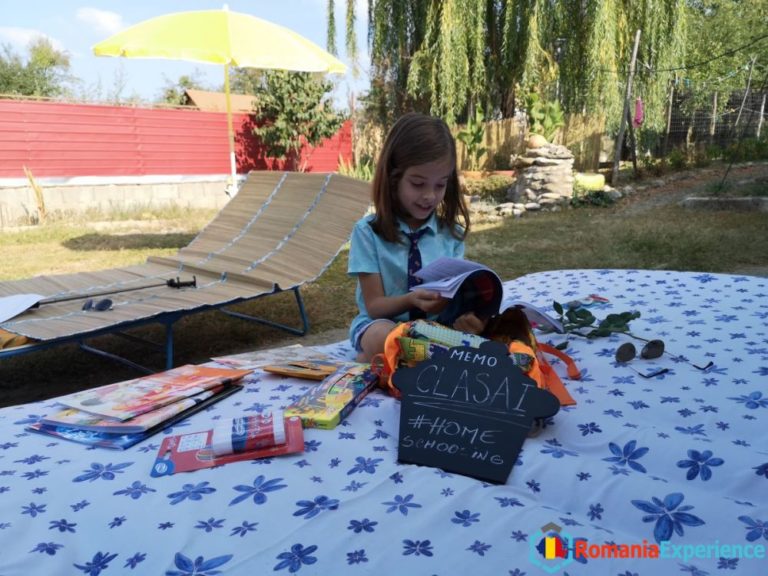
So how do you stay on the right side of the law? You use an umbrella school. This covers all the legal requirements for educating your children in Romania.
An umbrella school is an accredited foreign institution that allows you to teach your kids at home while providing the legal cover you need.
On paper, your child is enrolled in a regular private school abroad. In practice, you as the parent act as the teacher and guide their daily progress.
Depending on the institution you choose, they will offer varying levels of support, from textbooks and lesson plans to online instruction and grading.
Most umbrella schools that we found were private schools based in the UK or the US.
Here is how this works:
First, find and register with an accredited umbrella school. We used an option that is no longer available, so I can’t recommend specific schools, but it shouldn’t be difficult to find them.
Second, you have to pay the annual fee. These schools are usually affordable, sometimes costing just a few hundred Euros a year.
Third, keep your enrollment certificate handy. This document is your legal proof that your child is attending an authorized school, completely satisfying the requirements of the Romanian authorities should they ever knock at your door and ask questions.
As long as your chosen school is fully authorized to function in its home country, Romanian law accepts the enrollment.
The biggest challenge – for most parents – is to actually do the teaching. But this is something you probably already know about, so hopefully it won’t be a problem.
Also read: 60 Things a Foreigner Learned by Living in Romania
Our Experience with Homeschooling: The Good and the Bad

In our case, the biggest problem with homeschooling was an almost complete lack of social interaction with kids his age. In the small provincial city that we lived in, we were the only ones homeschooling.
Traditional school, despite its deep flaws, forces you to deal with bullies, make friends, and solve conflicts on your own. That social aspect prepares you for real life.
However, even with this CON, there are two important things that you have to consider:
1. We started homeschooling in 2020, when the world was apparently going to change forever.
2. While the “learning to solve problems” aspect is nice and letting your kid go through some less than ideal situations is good training for life, it’s also potentially damaging if it’s nothing but a constant struggle each day – which was our son’s situation, even though – fortunately – not with bullying.
He pretty much hated everything about school. As I said, it bored him a lot (our teacher always told us he finished every assignment first and even recommended not to do extra work with him at home because he’s too advanced and disrupts the class).
With the risk of sounding like that parent who thinks his kid is the best in the world, I will say that he was a bit more mature than most kids and this meant that even that social aspect that I keep mentioning didn’t provide a single genuine friendship.
During the breaks, he preferred to do math, for example, instead of playing with the others (most of the time, at least, because he sometimes felt like playing).
Sure, he had found some like-minded people in the class, but for the most part, he hated school and always came back home frustrated, angry, and bored. I don’t think this did him any good.
So we started homeschooling. My wife handled most of his education, and she did really well.
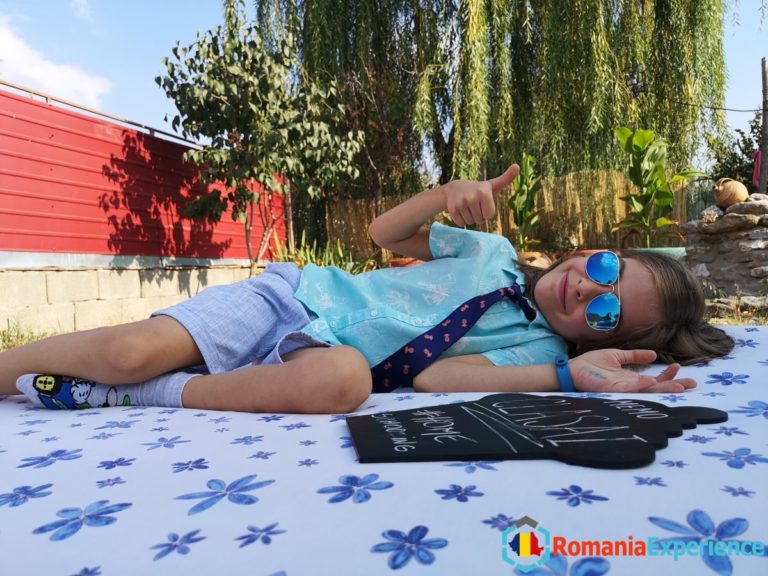
We followed the Romanian curriculum and actually using all the materials that they would at school, but also implemented some of the elements in the British Curriculum because that was the official one that he had to follow.
Overall, our son told us that he liked it better than regular school.
He also admitted that he missed his colleagues, but overall, it wasn’t that bad. At least from an educational standpoint, when he got back to traditional school in the third grade, he was at the same level as his colleagues.
And despite choosing the homeschool route, we still had a strict schedule in place, similar to a “traditional” one, with classes starting in the morning and ending at 12.
We also worked hard on getting our son to learn English – which was helped a lot by him only watching cartoons and Youtube (plenty of it) in English only.
He learned very fast and, even though his spelling is still worse than mine, he can now have a decent conversation with any English speaker. And I am really proud of that.
Homeschooling is definitely not for everybody. If both parents work, I would say that it’s nearly impossible because it is a full-time job.
Fortunately, my wife didn’t work and is patient enough to be a good teacher – at least at this level. I’m trying to help as much as I can, but with a full-time job on the side, it’s not easy for me.
We made it work, though, and neither of us regrets those years. It was challenging, it was not ideal or perfect, but it worked. If you have the time and the patience, taking this route in Romania is a possibility.

If you have questions about homeschooling in Romania or experiences to share, I would be more than happy to hear them.

I am a journalist and local expert who has been documenting life in Romania since 2013. Based in Constanta (after living in Bucharest and Drobeta Turnu Severin), I provide up-to-date, on-the-ground advice for expats and travelers. My articles are based on real life experiences and plenty of research – from paying Romanian bills to exploring the wild “Rawmania” countryside.
I have a positive opinion of homeschooling. For a long time I had worried some cranky Americans view that as a way to indoctrinate their children in some religious cult free from institutional interference, but I changed my mind when I used a textbook in my English class which had a whole chapter on the pros and cons of homeschooling. Gifted children especially benefited since they were bored with the slow pace of regular schooling.
The chapter rightly criticized all the wasted time in American schools where teachers had to take attendance, pass out materials, students had to walk from classroom to classroom, and spend time sitting in study hall, at lunch and in activities extraneous to education. American public schools had to “teach to the middle” so as not to leave behind the slowest students. Even the emphasis on sports at regular schools was criticized.
Homeschooled students claimed they could finish all their “home-schoolwork” in two hours and could then engage in extracurricular activities not offered at regular schools or even do a part time job. My experience with German schools is that there was much less time spent at school than in America and sports were only done once a week and then not very seriously. I think the wasted time alone is enough reason to homeschool. My younger sister homeschooled two of her daughters (my nieces) off and on for several years.
The first daughter was being bullied at school. After a year of homeschooling, she returned to a different school and developed into a very well adjusted young adult. Her younger sister also demanded to be homeschooled. Her formative years unfortunately coincided with the advent of the Internet and she “socialized” in a very negative forum that reinforced anorexic behavior. She began losing weight at an alarming rate and almost died. At the time, my sister assured me that this daughter was getting “social time” once a week through a special program for homeschooled children at a public school.
I suspect, however, that homeschooling still played a role in isolating that daughter and making her easy prey for that predatory Internet forum. Although she recovered from the anorexia, she has been a non-stop problem for my sister and my brother-in-law. Although she is in her early twenties, she seems to spend more time in “rehab” and “intervention” programs than at university. I’m not blaming homeschooling for her situation, just saying your worries about social isolation are understandable. I wish you great success with the homeschooling. And watch what your son is doing on the Internet!
Great stories, Stuart! I really appreciate it. Indeed, our son finishes the daily tasks in exactly two hours. But we still do a bit more since he really enjoys it.
Our son is on limited time on the computer and he spends most of the time watching people playing games. We sifted the ones that curse and let him do this since he really enjoys it (plus it’s in English, so it helps him catch a word or two). The internet is indeed very dangerous if kids are left unattended. Some of his colleagues at school were already playing some very age-inappropriate games (simply because parents had no idea what they were about).
I think for sure you guys made the right decision to homeschool. These are scary days, and l suspect the parents saying that God will decide who lives or dies are playing the odds. I think a lot of people have kids for the wrong reasons, and even though it´s not like they wish death would do their kids in, they relish the time away from them anyway. As long as he gets to socialize outside of being with you with his newfound friends, which he does, you´ll be fine. At least for the next couple of years, then you can reassess. He´s such a smart kid anyway :-).
It is indeed VERY difficult to spend so much time with anybody, even your kid. But he’s growing older and needs more alone time, we have a dog now to add some diversity and so far so good. Only time will tell if we really made the best choice, but we certainly chose what we think is the best for him after weeks of debates and pros/cons lists 🙂
We have home schooled our teen in the United States and it works. We have a 3 year old and we will be in Romania next year. I will be following this article. I believe we will home school much like you C. I want to be sure this Covid thing is under control before I risk our family by having our boy who would be a bug magnet hanging out in a school setting. We may home school a long long time too. I have a hope and a suspicion that socializing networks will come about to accomodate the issue you speak of. The system in the United States sets up events for kids to gather at and socialise. Zoo day.. Museum.. park events.. cave hikes all educational but designed to bring kids together so they can socialize. Perhaps you will connect with other parents homeschooling and set up an environment for socializing skills. Times are seriously changing and perhaps not all for the worse. School systems can really suck the world over in my opinion. Some exceptions.. you need to look closely at each school. Private schools, home schools and public schools all have the potential to be bad and it is up to us as parents to pick wisely. Good luck C. !
Thank you, Otto! As long as your kids speak English, it’s a lot easier to find all the courses they need. Socializing shouldn’t be a problem, as there are many expats and foreigners looking for the same. We’ll see how this turns out – so far, it’s still good and I a really surprised to see how quickly my son learns English. Hopefully in one year, he’ll write his first article here detailing his experience with homeschooling.
Thanks for sharing your experience with homeschooling in Romania.
I have a 3 1/2 year old son and we speak Romanian at home, but be needs to learn English as we currently live in US. We read picture books in English with him and it helps, but he needs more than that.
Would you mind sharing what course books and programs to teach English you used with your son and found useful? Thanks!
Mari, your son will surely learn English very well as he’ll be exposed to the language. We used various materials and I must say that progress is visible and I am impressed after almost one year of intensive practice (at least 3 times per week, for 1 hour, with me, but also lots of content in English – YouTube videos, books, movies, tv shows). Online sources that we used were IXL and Twinkle (both are really good and made a difference), but also English learning books that they use in school. Also, we speak with English as often as possible as practice makes perfect. Good luck!
Hello🤝
we are a family from israel and our two children are in homeschooling.
we are thinking about moving and leaving israel.there is no future for our children here.
romania is one of our options.
i was wandering if you leave in a place there are no schools at all are you obligated to put your child in ambrella school?
and do you know what kind of papers the goverment ask from the school your child is in?
I enjoyed reading your story so thank you 🙏
I think you might be able to dodge this a bit while your children won’t be Romanian citizens. Not 100% sure about this, but it would make sense.
However, it will be difficult to find a place with no schools. And even that happens, they should be enrolled in the nearest school available. So that would not make things easier.
So an umbrella school would be the easiest way out if they do ask for these details (which I doubt they will).
In Romania, the state uses something called “Foaie matricola” which is basically a record of the child’s grades and teacher’s recommendations for all courses they study.
Since schools outside Romania don’t use this, the children would have to take a test to be enrolled in the Romanian school system (the test is very easy, but in Romanian language).
But since you don’t want them in the system, you would be safe with any type of documentation offered by the umbrella school as long as it is proof that they are enrolled there.
Hello, can you please tell me what do you think about Cerehard, is it a good choice?
thank you
Emilia,
I just joined the “Home Schooling in Romania” group on Facebook. I found it very helpful.
Best of luck
Emilia, it depends on what you consider a good choice. We no longer are with Cerehard and returned to the traditional school system at a private school and we’re more satisfied.
But back to Cerehard, based on my knowledge since being a member, they do not operate as a school, but an NGO (ONG in Romanian). They are not accredited or recognized in Romania and there were talks (even threats of lawsuits) on their Facebook group as they are apparently not recognized as a British School either (at least they weren’t last year).
In other words, if you want to ever get back into the traditional school system, your children will have to at least take some tests at the new school and based on their level, they will be assigned to a specific year (but this happens when they study abroad too).
Hi. Please tell me an update if home schooling is now legal in RO. I heard somewhere it was. Is an umbrella school like Home Life academy still a good option? Will there be any legal consequences? My children are home schooled in the US and we want to move back to RO and keep home schooling. The kids are both US and RO citizens. I can’t afford private schooling and my religious beliefs are to school at home. How can I get the Romanian curriculum used in schools? Primarily just for teaching ROmanian. Thanks.
Yes, the best approach remains to choose an umbrella school. The law is in a gray area, making things very difficult for those who want to homeschool in Romania.
EDIT: Just saw a news article that a family from Bihor was sentenced to 4 months (with suspension – so not actually going to jail) for improperly homeschooling their children.
Do you have a link to the article? What do you mean by improperly homeschooling them? As in they should be in public school? Why are there so many international and private schools in RO then if alternatives are not allowed?
Hi Erin, private schools are okay as long as the Ministry approves/accredits them. The state changed the law in 2024, it looks like they are leaning towards making HS illegal FOR ROMANIAN CITIZENS. Your best bet would be to get the children enrolled in a private school if that is an option for you. The family in Bihor wasn’t really homeschooling, in my opinion.
You can read the article here: https://www.bihon.ro/stirile-judetului-bihor/parinti-din-bihor-condamnati-pentru-ca-si-au-retras-copiii-de-la-scoala-si-i-au-inscris-la-homeschooling-4486780/